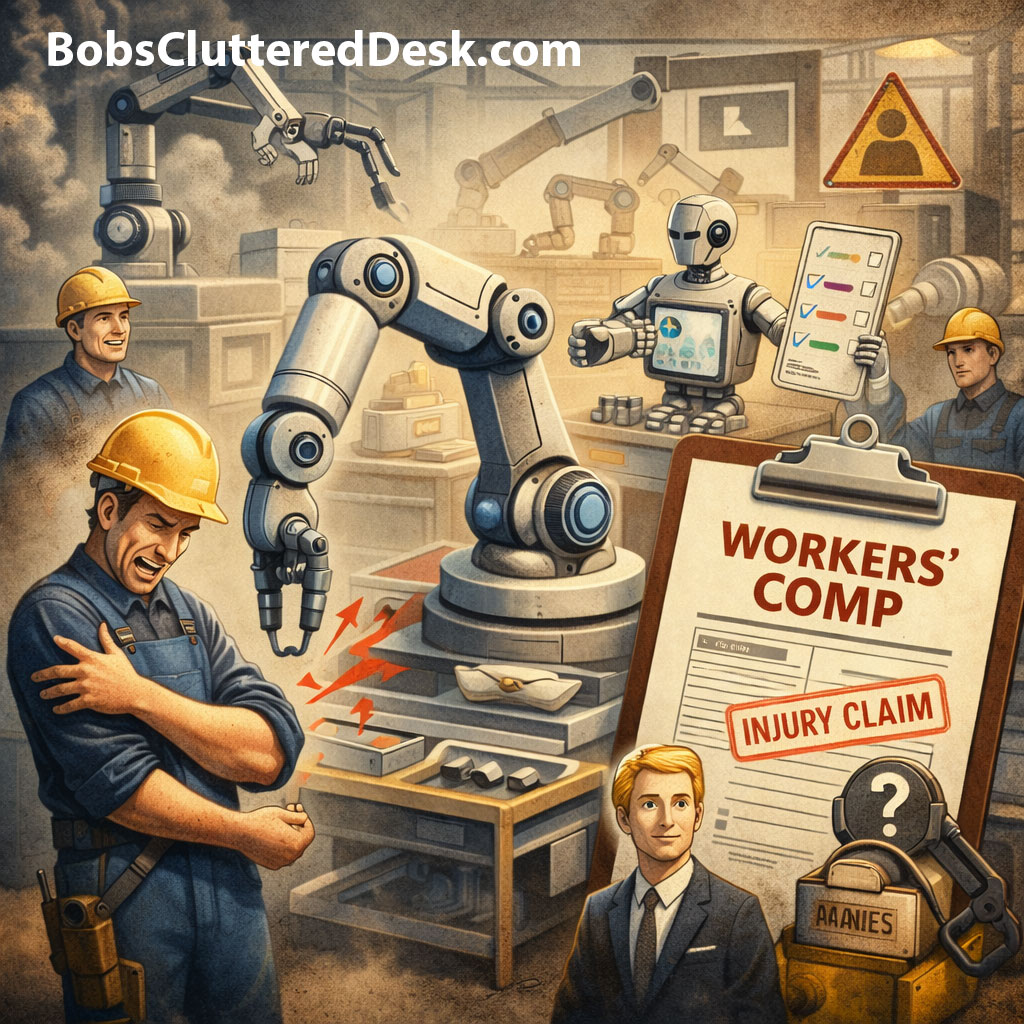
I’ve been watching the robotics news with the kind of morbid fascination usually reserved for horror movies where you know the ending won’t be good but you can’t look away. The latest development? Researchers have taught a robot to learn 1,000 different physical tasks in a single day using just one demonstration per task.
One day. One thousand tasks. One demonstration each.
For context, most human workers I know take about a week to learn where the bathroom is and another two weeks to figure out the coffee machine. But here we are, with robots that can watch you fold a shirt once and then immediately fold 999 other things without complaining, taking breaks, or filing for carpal tunnel syndrome.
As someone who spends an inordinate amount of time thinking about workplace injuries, I have questions. And concerns. And a growing suspicion that the workers’ compensation industry is about as prepared for the robot revolution as I am for running a marathon—which is to say, not at all.
Let’s talk about what these researchers actually accomplished. Using a method called “Multi-Task Trajectory Transfer” (which sounds like something from Star Trek but is apparently real), they taught a robot arm to perform everyday tasks like placing, folding, inserting, gripping, and manipulating objects.
The breakthrough isn’t just that robots can do these things—we’ve known that for years. It’s that they can learn them frighteningly fast by breaking tasks into simpler phases and reusing knowledge from previous tasks. Think of it as robots developing actual learning efficiency, like the workplace equivalent of finally figuring out that you can use the same password for multiple logins. Only legal. And far more sophisticated. And not just for porn.
This was tested in the real world, with real objects and real constraints. Not a pristine lab environment where everything goes perfectly. Actual messy reality, where the robot had to adapt and generalize to objects it had never seen before.
You know what that means? It means we’re not just talking about factory robots that repeat one motion endlessly. We’re talking about robots that might actually be trainable for complex, variable tasks.
And that’s where my workers’ comp radar starts pinging.
Here’s the conventional wisdom we’ve been hearing for years: robots will eliminate dangerous jobs, therefore workplace injuries will decrease, therefore workers’ comp costs will drop, and we’ll all live happily ever after in a safer workplace utopia.
This is what I call “optimistic thinking by people who have never filed a First Report of Injury.”
The reality is likely to be far more complicated and significantly more absurd.
Scenario One: The Training Injury Epidemic
If robots can learn 1,000 tasks from single demonstrations, guess who’s giving those demonstrations? Humans. Lots of humans. Demonstrating tasks over and over again to train different robots in different facilities doing different work.
I can see the claims now:
“Employee strained back demonstrating proper lifting technique to Robot Unit 7 for the 47th time this week.”
“Worker developed tennis elbow from repeatedly showing robotic arm the correct way to insert widgets into holes.”
“Repetitive demonstration syndrome—a new occupational disease affecting robot trainers nationwide.”
We’re going to create an entirely new category of workplace injury: Robot Training Repetitive Strain. Mark my words, in five years there will be an ICD code for it.
Unless, of course, we just train a robot to train other robots. Sort of a robotic “Train the Trainer” scenario. If that’s the case, forget everything I just said, which you’re likely to do anyway…
Scenario Two: The “But The Robot Did It Wrong” Defense
Robots learning from single demonstrations sounds efficient until you realize that humans demonstrating tasks aren’t always doing them correctly. Or safely. Or in ways that translate well to mechanical reproduction.
Picture this: An employee demonstrates how to stack boxes. The robot watches once, learns the task, and then stacks 10,000 boxes exactly the way the employee did it—including the part where the employee slightly twisted their torso in a way that’s fine for one box but devastating over ten thousand repetitions.
Now the robot is creating ergonomic nightmares at scale. And when the next human worker comes along to work alongside this robot, they’re expected to keep up with a machine that’s performing tasks with all the efficiency of automation and all the poor technique of Steve from shipping who threw his back out six months ago.
Who’s liable for that? The employer? The robot manufacturer? Steve? The researchers who created the learning algorithm? The graduate student who was supposed to be supervising but was actually checking their phone?
I can hear the defense attorneys now: “Your Honor, my client cannot be held responsible for injuries caused by the robot’s faithful reproduction of improper human technique.”
Scenario Three: The Collaboration Catastrophe
The research focuses on robots learning tasks independently, but the real world doesn’t work that way. Robots and humans will be working side by side. And humans, bless them, have this terrible habit of not always doing what they’re supposed to do.
Robots, on the other hand, do exactly what they’ve learned. Every time. Without variation. With no ability to read social cues, react to unexpected human behavior, or understand that “hold on a second, I need to adjust this” means “don’t continue your programmed task right now.”
The collision scenarios write themselves:
“Employee reached for tool at the exact moment Robot Unit 12 executed its learned reaching motion, resulting in a broken finger and a very confused robot.”
“Worker stepped into robot’s learned pathway because they assumed the robot would see them and stop, like a human would. Robot did not see them. Robot did not stop. Robot had learned to complete tasks efficiently, not to play safety lookout.”
We’re going to see a whole new category of “robot-human interface injuries” that make current machinery accident claims look simple by comparison.
Here’s something the robotics researchers probably aren’t thinking about: robots that can learn 1,000 tasks are complex machines. Complex machines break down. Complex machines need maintenance.
And maintenance creates injuries.
Currently, factory robots are relatively predictable. They do one thing, they do it repeatedly, and when they break, specialized technicians fix them following established protocols.
But robots that can learn and adapt? That’s a different animal. Or rather, a different machine pretending to be different animals depending on what it learned that day.
The technician who comes to fix a multi-task learning robot is going to have a much harder time predicting its behavior, especially if it’s malfunctioning in ways that relate to its learned behaviors rather than its core programming.
“The robot was supposed to be in safe mode, but apparently it had learned that ‘safe mode’ was a suggestion rather than a requirement, based on watching Gary in production override the safety protocols 37 times last month.”
We’re going to see injuries from robot maintenance that make current machinery accidents look straightforward by comparison.
Here’s the thing nobody wants to talk about: if robots can really learn this fast and this well, they’re going to replace a lot of human workers. That should reduce workplace injuries, right?
Wrong. Or at least, not exactly.
What we’re more likely to see is a bifurcation of the workforce:
- Highly skilled workers who maintain, train, and collaborate with robots
- Workers doing tasks that robots haven’t learned yet (or can’t do profitably)
Both categories are going to have injury risks. The first category will have high-complexity, potentially catastrophic injuries from working with sophisticated machinery. The second category will have injuries from increasingly difficult or undesirable tasks that weren’t worth teaching robots to do.
So we won’t eliminate workplace injuries. We’ll just redistribute them in ways that make actuarial predictions even harder than they already are.
The research paper talks about robots learning from single demonstrations with impressive efficiency. What it doesn’t talk about is human psychology.
Humans are going to be weird about robots. We’re going to anthropomorphize them. We’re going to trust them too much or too little. We’re going to expect them to behave like humans, even when they’re explicitly not human.
And this is going to create injuries.
“I thought the robot would see me and stop.” “I assumed the robot understood I was joking when I said ‘let’s speed this up.'” “The robot seemed to be struggling, so I tried to help it, and that’s when it caught my hand in its gripper, and welded it to the car frame.”
We’re going to see injuries that stem not from robotic failure or human error in the traditional sense, but from the fundamental mismatch between human expectations and robotic behavior. And good luck creating safety protocols that address “worker assumed robot had common sense.”
Look, I’m not saying robots that learn 1,000 tasks in a day are inherently bad. The technology is genuinely impressive. In theory, it could lead to safer workplaces by taking over dangerous tasks more effectively.
In theory.
In practice, we’re probably looking at a messy transition period where robots and humans work together in ways neither is fully prepared for, creating novel injury patterns that our current workers’ compensation system is spectacularly unequipped to handle.
The good news? This is going to create a lot of work for claims professionals, safety consultants, attorneys, and people like me who write about these things. Job security through complexity.
The bad news? Pretty much everything else.
A robot learning 1,000 tasks from single demonstrations is a technological marvel. It represents genuine progress in making robots more flexible and useful.
It also represents a potential workers’ compensation scenario that we’re not remotely prepared for.
We need to start thinking now about:
- How to regulate robot training and demonstration protocols
- How to document robot learning for injury investigation purposes
- How to allocate liability when robots learned from flawed human demonstrations
- How to protect workers who collaborate with adaptive learning robots
- How to train the next generation of safety professionals to understand robotic learning systems
Instead, we’re probably going to wait until the first major robot-related injury lawsuit, scramble to respond, and end up with a patchwork of inconsistent regulations that satisfy nobody.
If that sounds cynical, it’s because I’ve been in workers’ compensation long enough to know that we tend to regulate based on disasters rather than prevent them. We’re very good at closing the barn door after the robot has already learned to escape.
So sure, let’s celebrate the robots learning 1,000 tasks in a day. It’s impressive. It’s innovative. It’s the future.
Just don’t be surprised when that future includes claims for “robot demonstration syndrome,” liability disputes over machine learning algorithms, and safety professionals trying to write protocols for scenarios that didn’t exist two years ago.
I’ll be over here, watching the robot revolution unfold and wondering if anyone’s thought about updating our workers’ compensation statutes to address injuries caused by machines that learn faster than our legal system can adapt.
Spoiler alert: they probably haven’t.