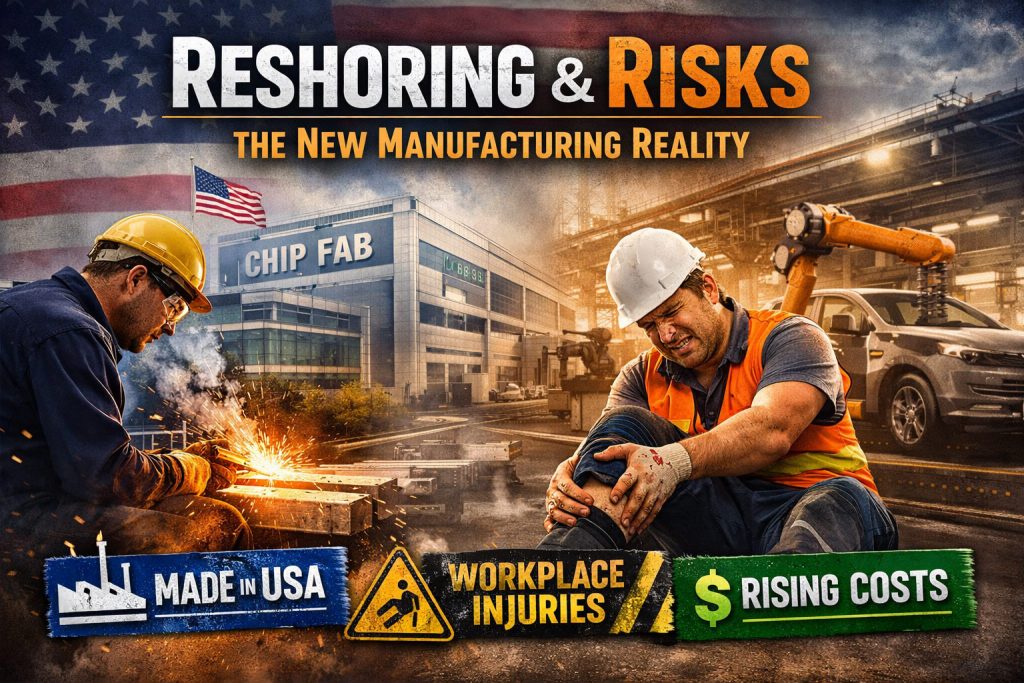
There’s something happening in America that hasn’t happened in a generation. We’re building things again. Or at least, we’re talking very seriously about building things again.
Approximately 230,000–250,000 manufacturing jobs were announced for reshoring or foreign direct investment in recent years, according to the Reshoring Initiative. The CHIPS and Science Act is transitioning from funding announcements to actual production facilities. Investment pledges are flowing. Politicians on both sides of the aisle are suddenly falling over themselves to champion domestic manufacturing, having apparently just discovered that products come from somewhere other than Amazon Prime and that “Made in America” involves actual Americans making actual things. The pendulum that swung toward outsourcing for the past four decades is creaking back in the opposite direction.
And all I can think is: is the workers’ compensation system remotely ready for this?
Here’s what we know about manufacturing jobs: they break people. Not always, not catastrophically, but with a grinding consistency that the service economy never quite matched.
The most recent statistics indicate the total recordable injury rate in manufacturing sits at 2.8 cases per 100 full-time workers. That’s higher than most industries, and in recent years, manufacturing has accounted for approximately 200,000–230,000 nonfatal workplace injuries annually. These aren’t paper cuts and carpal tunnel. We’re talking about serious musculoskeletal disorders that account for nearly one-third of all serious workplace injuries. Strains, sprains, back injuries from lifting and overexertion. The kind of injuries that put workers out for weeks or months at a time.
Manufacturing injury claims account for billions of dollars annually in direct workers’ compensation expenses. When you add the indirect costs—lost productivity, replacement workers, overtime for remaining staff—the number likely triples.
And here’s the kicker: we’re about to scale this up. Significantly.
The cheerleaders for reshoring love to talk about the “skills gap.” Some estimates say there are nearly 500,000 unfilled manufacturing jobs right now because modern factories require workers who can code, troubleshoot robotics, and work with AI-enhanced systems. We’ve spent a generation training people to optimize their LinkedIn profiles and navigate corporate Slack channels, but somehow forgot to mention that somebody still needs to know how a robotic assembly line works when it starts making alarming noises at 2 AM. Fair enough. But there’s another skills gap nobody seems to be addressing: the one in our workers’ compensation infrastructure.
Think about it. We’ve spent the last 30 years hollowing out our manufacturing base. The institutional knowledge about managing high-volume industrial injury claims has atrophied right alongside the factories. Many of today’s claims professionals have spent their entire careers handling office workers with repetitive strain injuries and retail employees who slipped on wet floors. The complexity of managing traumatic amputations, chemical exposures, and catastrophic machinery accidents? That’s not in most people’s current skillset.
Federal and private forecasts project a doubling or greater expansion of U.S. semiconductor manufacturing capacity by the early 2030s. Intel, TSMC, and others are bringing facilities online. These aren’t just big employers—they’re employers with unique, highly technical injury risks. Are we training enough industrial hygienists who understand semiconductor manufacturing hazards? Do we have enough medical case managers with experience handling the specific injuries these facilities produce?
The answer, I suspect, is no.
Here’s another uncomfortable truth: reshoring isn’t distributed evenly. It’s concentrating in specific regions—the Rust Belt states trying to reclaim their manufacturing heritage, the Southeast courting new facilities with tax incentives, and scattered zones around the country positioning themselves as manufacturing hubs.
This creates predictable pressure points. Local medical provider networks in these areas will suddenly face an influx of complex industrial injuries. Emergency rooms and orthopedic practices that have been handling relatively routine cases will need to gear up for more severe trauma. Occupational medicine programs will need expansion.
And the workers’ compensation insurance infrastructure in these regions? It needs to scale proportionally. We’ll need more adjusters, more case managers, more medical reviewers, and more return-to-work coordinators who actually understand industrial environments.
The reshoring reports I’ve read focus heavily on the difficulty of finding production workers with the right technical skills. You know what they don’t mention? The equal difficulty of finding experienced workers’ comp professionals who know how to manage manufacturing claims at scale. You can’t just pull someone from handling restaurant injuries and expect them to seamlessly transition to managing claims from a semiconductor fab or an automotive stamping facility.
Let’s talk about money, because eventually someone has to pay for all of this.
U.S. manufacturing labor costs are already substantially higher than overseas competitors—roughly $25-30 per hour compared to $6-7 in China. We’re told that automation and productivity will narrow this gap. Maybe. But workers’ compensation is part of that labor cost equation, and it’s not getting cheaper – or won’t be if significant injury rates increase.
The reshoring advocates like to point out that modern manufacturing facilities will be highly automated, reducing injury exposure. That sounds great in theory. In practice, automation creates its own injury patterns. More sophisticated equipment means more complex failure modes. Workers aren’t lifting heavy objects manually anymore—they’re troubleshooting million-dollar robots that occasionally malfunction in spectacular ways. Different risks, not necessarily lower risks.
Moreover, the early adopters in reshoring are discovering that the real differentiator isn’t just having automated equipment, it’s having workers who can keep that equipment running. As one supply chain report noted, in places like Shenzhen, equipment failures are fixed within minutes because expertise sits close to the production line. Developing that same capability here means workers working in close proximity to complex machinery during troubleshooting and repair. That’s inherently hazardous.
So as we’re calculating whether reshoring makes financial sense, are we factoring in realistic workers’ compensation costs? Or are we using optimistic projections based on service industry injury rates?
If this reshoring trend is real and sustainable—and there’s legitimate debate about whether it is—then the workers’ compensation industry needs to get serious about rebuilding capabilities we let atrophy.
We need training programs for claims professionals specifically focused on manufacturing injuries. Not generic “industrial claims” training, but deep dives into the specific injury patterns of modern manufacturing: robotics-related trauma, chemical exposure management, ergonomic injuries from precision assembly work.
We need to rebuild relationships between workers’ comp carriers and occupational medicine programs. Many of the best occupational health clinics closed or downsized when manufacturing declined. The ones that remain will need to expand, and new ones will need to be established in reshoring zones.
We need return-to-work programs designed around manufacturing realities. The “light duty” options that work in an office environment don’t translate to a semiconductor fab. We need employers and insurers working together on transitional work programs that actually fit manufacturing operations.
And candidly, we need workers’ comp carriers to start thinking like long-term partners in this reshoring effort rather than just underwriters trying to avoid adverse selection. If domestic manufacturing is genuinely returning, there’s a role for proactive risk management and injury prevention programs that go beyond basic safety compliance.
Here’s where I get skeptical. Reshoring has bipartisan support right now because it polls well and makes for excellent photo opportunities. Bringing jobs back to America is a great political message. You can get fantastic footage standing in front of a factory, wearing a hard hat, talking about American workers and American strength. What you can’t get is equally compelling footage attending a workers’ compensation hearing or championing increased funding for occupational medicine programs. Funny how that works.
But workers’ compensation reform? Safety regulation enforcement? Funding for occupational medicine programs? Those are harder sells that don’t fit on a campaign mailer.
If we’re serious about reshoring, we need to be equally serious about building the workers’ compensation infrastructure to support it. That means funding, training, regulatory attention, and political will. I’m not convinced we have the latter.
The honest answer is no. Not remotely.
We have pockets of excellence—regions with strong manufacturing traditions that maintained their workers’ comp expertise. We have individual carriers and employers who take safety and injury management seriously. But as a system? We’re not prepared for a significant scaling of manufacturing employment.
That doesn’t mean reshoring is doomed, or that we shouldn’t pursue it. It means we need to be realistic about the challenges and start addressing them now rather than after the injuries start piling up.
We need to rebuild institutional knowledge. We need to invest in training and infrastructure. We need to modernize our approach to managing manufacturing injuries for 21st-century facilities, not 1970s factories. And we need political leaders to understand that “bringing manufacturing back” is incomplete if we don’t also bring back the systems to protect manufacturing workers.
Because here’s the thing about building things: someone always gets hurt in the process. The question isn’t whether injuries will happen—they will. The question is whether we’ll be ready to handle them competently, fairly, and with the seriousness they deserve.
Based on where we are today, I have my doubts.
But I’m willing to be proven wrong. In fact, I’d love to be proven wrong. I’ll be waiting for comprehensive workers’ compensation infrastructure reform with the same breathless optimism I usually reserve for the day someone finally writes a three-page workers’ comp statute that normal humans can understand. Which is to say, I’m not holding my breath, but I admire the dream.
Because if reshoring is really happening, and if we actually manage to rebuild American manufacturing capacity, the workers who make it happen deserve better than a workers’ compensation system that’s unprepared for their needs.
We’ll see. 2026 has a way of clarifying whether ambitious plans meet reality or crumble against it. I’ll be watching the injury statistics just as closely as the employment numbers.
Someone should.
I would hope we build/manufacture smarter and safer. Utilizing intelligent training, HR policies that provide reasonable break and stretch time, and ergonomic design to lessen musculoskeletal injuries.
John, I would hope so to, but only time will tell.